- Batumi is no longer one market. It is several different markets within one city
- The market is growing, but weak properties are no longer forgiven
- Renovation is becoming part of the investment strategy
- Yield now has to be protected through quality
- Buyers have become more mature
- Tourism remains a strong foundation, but its quality is changing
- Batumi is gradually moving beyond the image of a seasonal resort
- Diversification inside Batumi may be more effective than random purchases in different countries
- What should investors do in 2026?
- Conclusion
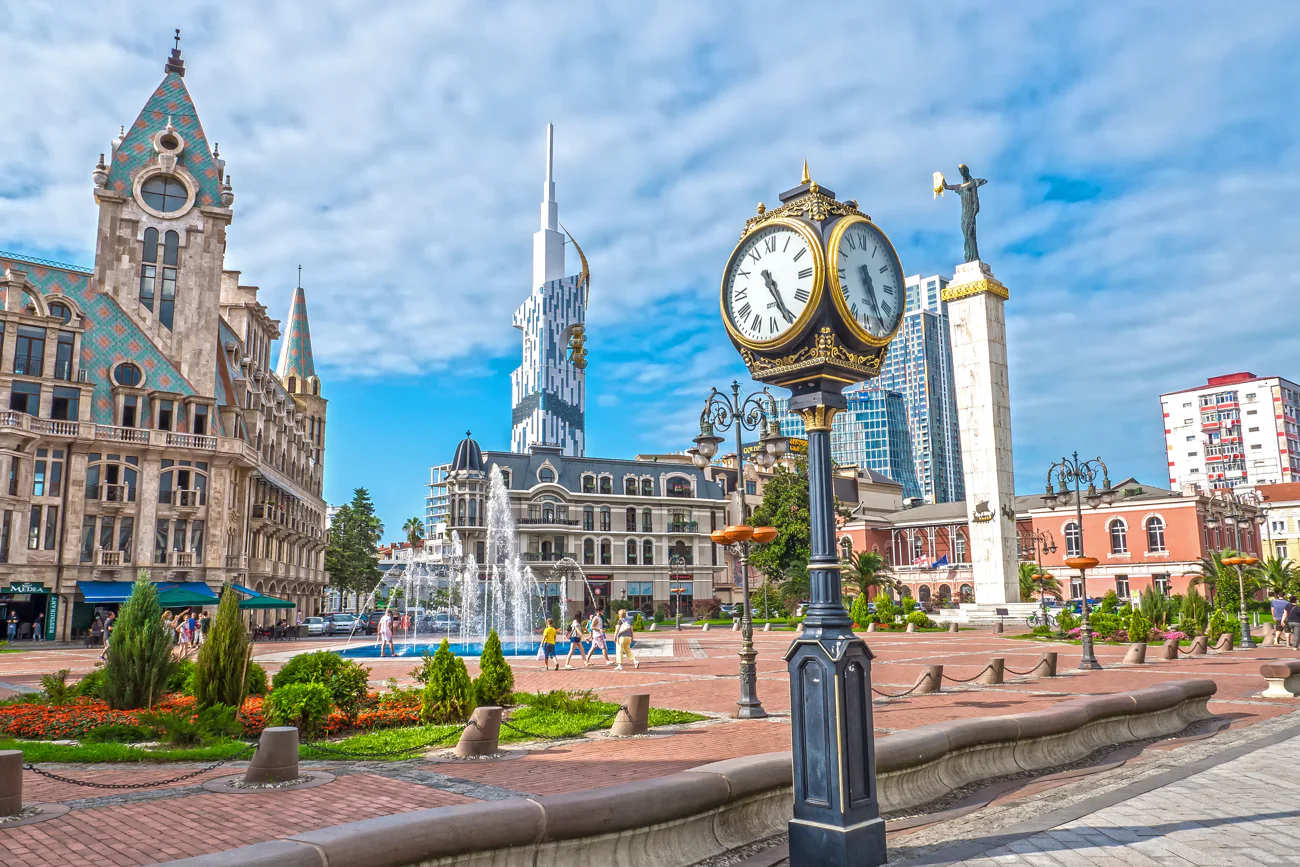
The Batumi real estate market in 2026 can no longer be described by the old formula: “buy something near the sea and wait for it to grow.” That logic worked when the market was simpler, demand was less selective, and many buyers made decisions emotionally.
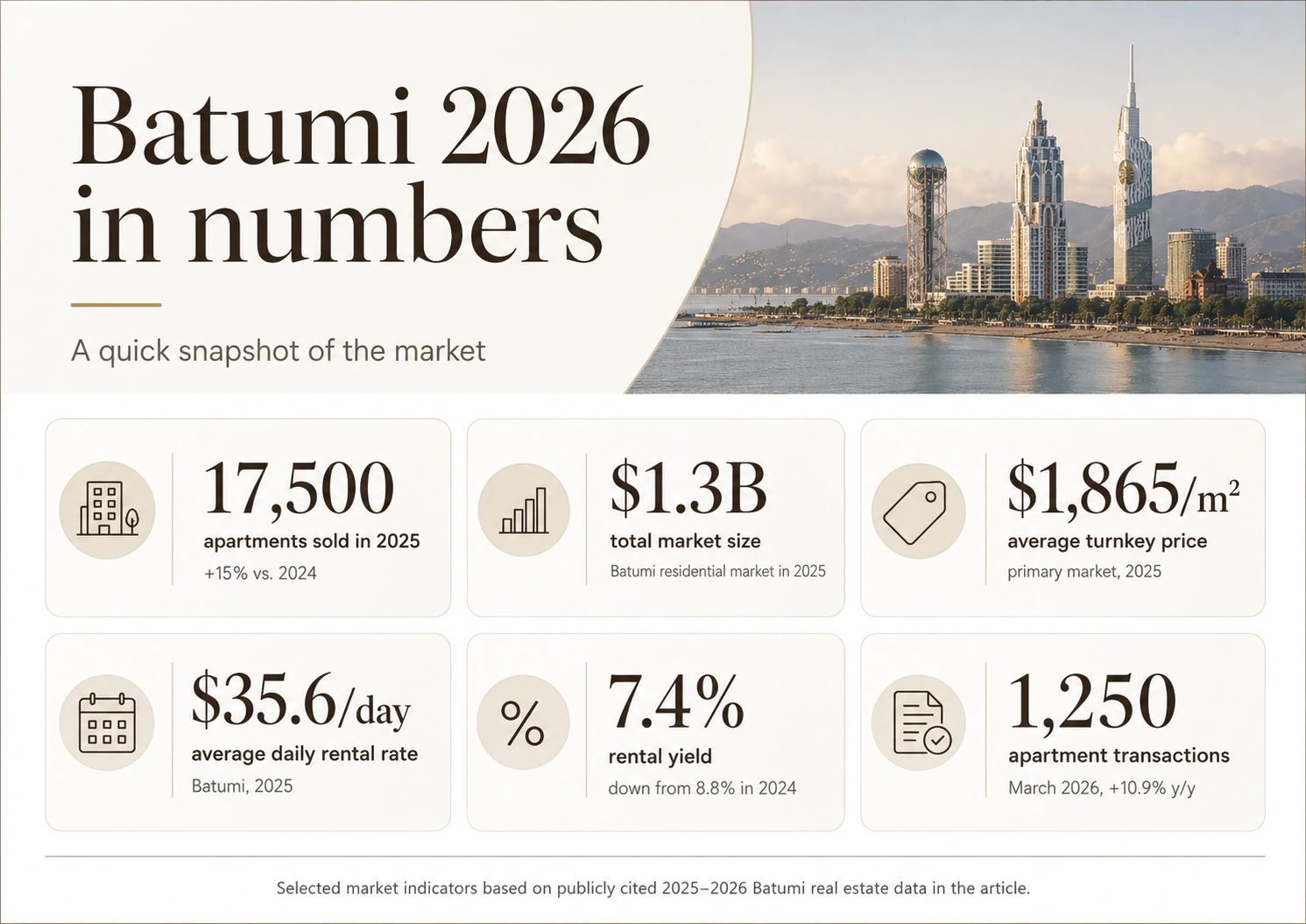
Today, the situation is different. Batumi has not stopped growing, and the market has not burned out. On the contrary, it has become more mature. According to Galt & Taggart, 17,500 apartments were sold in Batumi in 2025, 15% more than a year earlier, while the total market size reached $1.3 billion. The average price of turnkey apartments on the primary market increased from $1,700 per m² in 2024 to $1,865 per m² in 2025.
But the key point is not simply that prices are rising again. The more important point is that the market has become more selective. Strong properties continue to grow in value and attract tenants. Weak properties increasingly have to compete through discounts, lower prices, and promises.
That is why buying real estate in Batumi in 2026 is no longer just about choosing a district or a developer. It is an investment strategy: what to buy, how to renovate it, who the future tenant will be, who will manage the property, and how liquid the apartment will remain several years from now.
Batumi is no longer one market. It is several different markets within one city
From the outside, Batumi may still look like simply “a city by the sea.” But for an investor, that description is now too broad.
Today, Batumi contains several different investment scenarios. Heroes Alley, New Boulevard, Old Batumi, Gonio, inner city areas, and peripheral locations all work differently. They have different audiences, different seasonality, different growth potential, and different risks.
Heroes Alley is a bet on business activity, relocation demand, and tenants who need the city, not just the beach. In 2025, this area recorded 3,900 sales, while the average price of turnkey apartments reached $2,100 per m².
New Boulevard remains the largest market segment by transaction volume, with 6,800 sales in 2025 and an average turnkey price of $1,760 per m². But this is exactly where choosing the right property matters most. There is a lot of supply in the area, and tenants can easily compare apartments: view, renovation, furniture, lobby condition, elevators, management company, photos, and reviews.
Old Batumi is the most expensive and limited segment. In 2025, the average price of turnkey apartments here reached $3,030 per m². This is not just an investment “near the sea”; it is a purchase of urban environment, walkability, architecture, restaurants, the old city atmosphere, and limited supply.
Gonio-Kvariati is a separate product. There are fewer transactions there, but ecology, peace, views, and a private escape feeling play a much bigger role. According to Galt & Taggart, the average turnkey apartment price in this area in 2025 was $2,050 per m².
So the right question in 2026 is not: “Where is it cheaper to buy?”
The right question is: “What income scenario am I actually buying?”
The market is growing, but weak properties are no longer forgiven
Fresh data for March 2026 shows that market activity remains strong. According to BM.ge, a Georgian business media outlet, based on data from local real estate analysts, Batumi recorded 1,250 apartment transactions in March 2026, 10.9% more than a year earlier. The total sales volume of apartments and houses increased by 33.4%, reaching $81 million.
This does not look like a market that has stopped. But it also does not mean that every property is automatically a good investment.
At Arcus, we see this very practically. An apartment does not live inside a market report after purchase. It enters real life: renovation, material selection, budgeting, photography, Airbnb, property management, guest reviews, maintenance issues, seasonality, and competition with neighboring apartments.
And this is where it becomes immediately clear what was a real investment and what was simply a purchase of square meters.
Two studios with the same size can produce completely different results. One can become a well-designed rental product: smart layout, good lighting, proper storage, quality sanitaryware, a functional kitchen, strong visual identity, and a clear style. The other may remain just “a studio with renovation,” easily replaceable by dozens of similar listings.
In 2026, the market rewards the product, not just ownership.
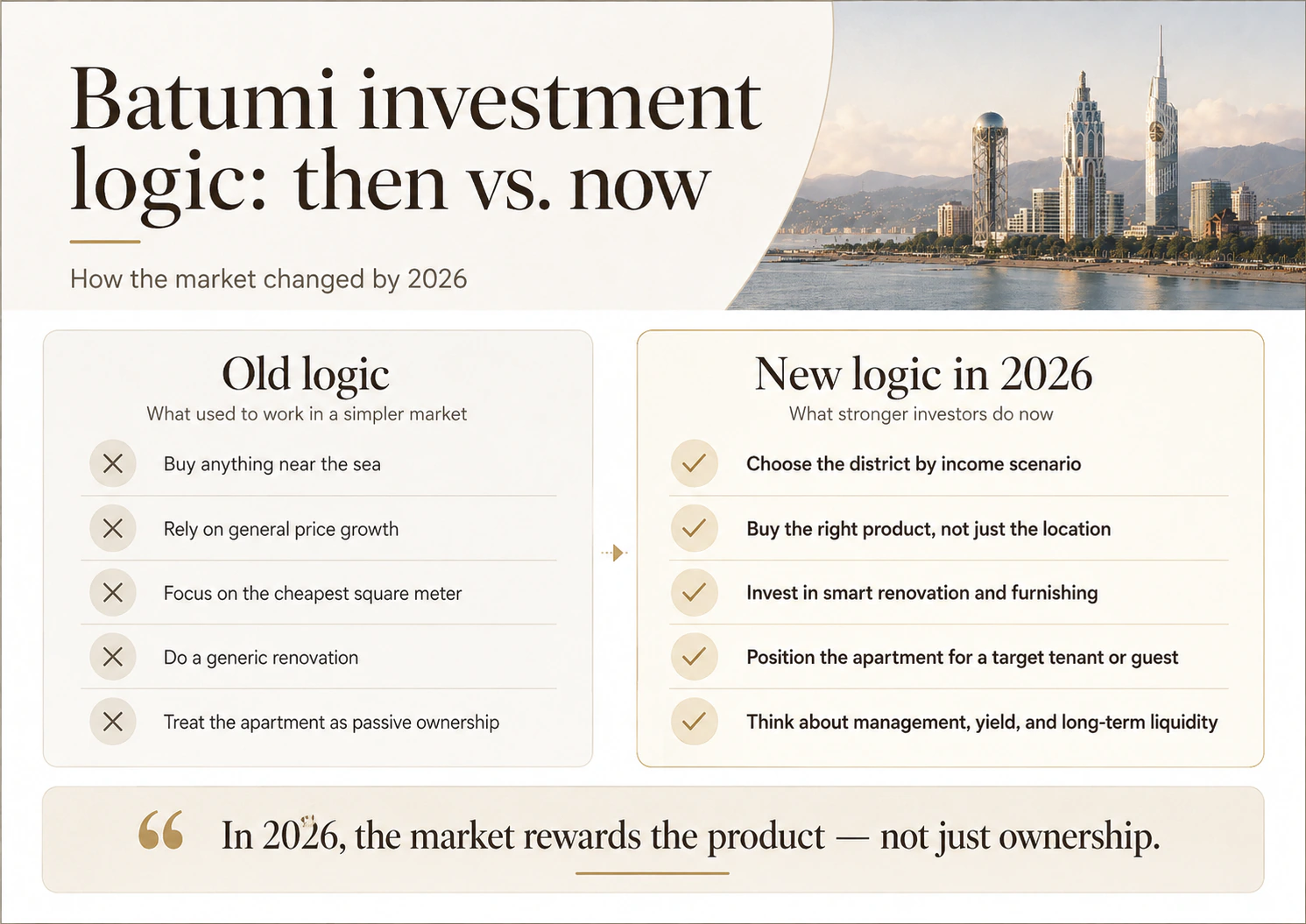
Renovation is becoming part of the investment strategy
For many investors, renovation is still seen as a technical stage: buy an apartment, choose tiles, install a kitchen, bring in a bed — done.
But for Batumi in 2026, this approach is too weak.
Renovation in an investment apartment is not just finishing work. It is the packaging of the asset. It affects how the apartment looks in photos, which guest will choose it, how much they will be willing to pay, what reviews they will leave, and how quickly the property will age.
This is especially important in Batumi, where many apartments compete in the same segment: studio, sea, new building, short-term rental. If many units have a similar view and similar size, the winner is not the one who simply made a “normal renovation.” The winner is the one who created an apartment designed for a specific tenant or guest.
For short-term rental, emotion, visual presentation, and convenience are crucial. For long-term rental, practicality, storage, durable materials, a proper kitchen, a workspace, a good shower, and the feeling that the apartment is comfortable to live in — not just to sleep in — become more important.
That is why a good renovation in Batumi is not an expense that should be reduced as much as possible. It is a tool for protecting rental yield.
Yield now has to be protected through quality
According to Galt & Taggart, the average daily rental rate in Batumi in 2025 remained almost stable at $35.6 per day, while rental yield decreased from 8.8% in 2024 to 7.4% in 2025.
This is an important signal: purchase prices grew faster than rental income.
In practice, this means that investors can no longer rely only on general market growth. When the entry price becomes higher, every mistake after purchase becomes more expensive.
A poor layout reduces occupancy. Cheap materials wear out faster. Weak furniture damages reviews. Bad photography lowers conversion. Poorly planned renovation increases maintenance costs. Chaotic management eats into profitability, even if the apartment was bought in a good location.
In 2026, yield in Batumi is not created only at the moment of purchase. It is created after the deal — through renovation, furnishing, positioning, and management.
Buyers have become more mature
A few years ago, the market had a lot of emotional demand. People bought “something near the sea,” “before prices go up,” or simply “because Batumi is growing.” That kind of demand has not disappeared completely, but it is no longer the main driver of the quality market.
We now see three more mature groups of buyers.
The first group consists of owners who have already gone through the first cycle. They bought cheaper apartments, faced renovation, management companies, competition, expenses, and realized that not every property “near the sea” automatically works. These investors are now moving into stronger projects and more understandable locations.
The second group is foreign investors who calculate the numbers. They are not interested only in renders and promised returns. They want to understand service costs, legal clarity, liquidity, renovation quality, real off-season rental demand, and a clear exit scenario.
The third group is local capital. When Georgian entrepreneurs invest in quality real estate inside the country, it is a strong signal. Local investors understand the context better: which districts are actually developing, where infrastructure is changing, where prices are already overheated, and where there is still potential.
These buyers make the market more complex, but also healthier.
Tourism remains a strong foundation, but its quality is changing
Batumi continues to benefit from tourism, but the number of visitors is not the only important factor. The structure of that flow matters: who comes, for how long, with what budget, and for what purpose.
According to Geostat, in the first quarter of 2026, international visitors made 997.5 thousand tourist visits, 4% more than a year earlier. Adjara remained one of the key regions for visitors, with 306 thousand visits in the first quarter.
Another important detail: the average length of stay increased to 5.87 nights, compared with 5.50 nights a year earlier. For the rental market, this is a positive signal. The longer the stay, the more important apartment quality, comfort, and proper equipment become — not just a pretty picture near the sea.
There is also a visible increase in traffic from higher-spending markets. According to Xinhua, visits from the EU and the United Kingdom grew by 30.2% in the first quarter of 2026 and reached 96,226 visits. The United States, the United Kingdom, and Germany were also among important source markets.
For apartment owners, this means the market is becoming more demanding. A higher-paying guest does not want just “a place to sleep.” They expect clean design, a comfortable shower, a good bed, a proper kitchen, quality textiles, fast internet, and the feeling that someone actually thought about the apartment.
Batumi is gradually moving beyond the image of a seasonal resort
Another important shift is that Batumi is becoming less dependent on the image of a purely summer destination. Georgia is strengthening its position as a destination for tourism, events, business, and regional logistics.
The economic background also remains strong. According to BM.ge, citing Geostat, Georgia’s economy grew by 10.7% in March 2026, while growth for the first quarter reached 9.1%. Construction, transport and storage, IT and communications, and professional and technical activities were among the sectors contributing to growth.
There is also an infrastructure factor. The Samsun–Trabzon–Sarpi high-speed railway project is intended to connect cities along Turkey’s Black Sea coast and create a transport link toward the Georgian border. For Adjara, such projects are important not as an instant “price trigger,” but as part of the long-term strengthening of the Black Sea region.
There is also an image factor: the FIFA Council appointed Georgia and Armenia as hosts of the FIFA U-20 World Cup 2029. This does not automatically increase apartment prices, but it does strengthen the country’s international visibility and confirms that Georgia is increasingly appearing on the map of major events.
For real estate, this matters indirectly — through awareness, events, people, and more reasons to visit not only in summer.
Diversification inside Batumi may be more effective than random purchases in different countries
There is a common stereotype that real estate diversification must mean different countries: one apartment in Georgia, one in Dubai, one in Bali, and one somewhere in Europe.
But for a private investor with a budget of $300,000–500,000, this strategy often creates not diversification, but operational chaos. Different jurisdictions, different taxes, different management companies, different expense currencies, different rental rules, different risks, and almost no control over service quality.
In Batumi, another strategy is possible: diversify not by flags on the map, but by income scenarios within one growing market.
One property can work for stable long-term rental. Another can target short-term tourist demand. A third can be focused on capital growth in a developing location. One district can be more urban, another more resort-oriented, and another more niche and ecological.
The advantage of this model is manageability. One city, one team, one renovation standard, one operational logic, and one quality control system.
This is where investors get real leverage: not just buying real estate, but building a portfolio that can be renovated, photographed, rented, serviced, and improved systematically.
What should investors do in 2026?
The main advice is simple: do not start with the question “How much is the price per square meter?”
Price per square meter matters, but it does not answer the most important question: what will happen to this apartment after purchase?
Before making a decision, it is worth understanding:
- who will live in this apartment;
- whether the district fits the chosen rental scenario;
- whether the building has proper management;
- what the competition will look like in two or three years;
- how much renovation and furnishing will realistically cost;
- whether the apartment can become a strong visual product;
- how easy it will be to sell the property in the future.
In 2026, a good property in Batumi is not necessarily the cheapest one. And it is not necessarily the most expensive one. It is a property with a clear logic: district, layout, renovation, tenant, management, and exit strategy.
Conclusion
The Batumi real estate market in 2026 has not become simpler. But it has become more interesting for those who approach buying professionally.
The gold rush, when almost any concrete box could be bought with the expectation of fast growth, is fading. It is being replaced by a more mature market, where random purchases lose ground and thoughtful decisions win.
Batumi continues to grow, tourism remains strong, Georgia’s economy shows high growth rates, and infrastructure and international visibility are improving. But competition is also increasing. That means investors need to look deeper — not only at the price, but at the future life of the apartment.
That is why buying real estate in Batumi in 2026 is not simply a question of price per square meter. It is a question of strategy: which property to buy, how to prepare it, how to rent it out, and how to make sure that several years from now it remains a clear, beautiful, and liquid asset.